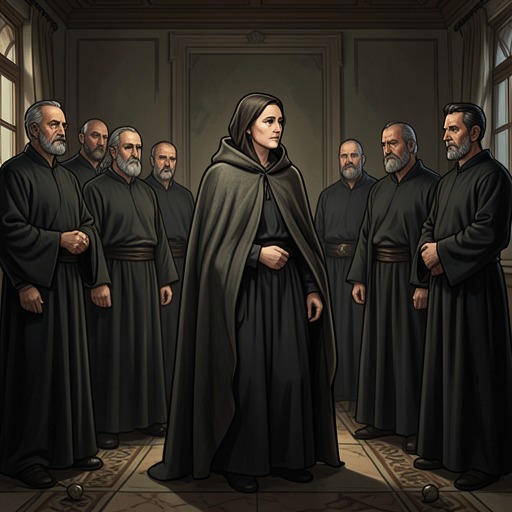
Catalina and Doña Elvira
The Constant PrincessCatalina and Doña Elvira’s relationship is a close but ultimately broken alliance, shaped by service, trust, and the political uses of personal intimacy. Elvira helps Catalina navigate the English court and becomes essential to her plan to remain in England and marry Harry Tudor. But when Catalina later discovers that Elvira is acting against her father’s interests, their bond ends in anger and separation.
Attendant and confidante
Before Catalina’s marriage, Elvira is among those who attend to her directly: she helps dress the Infanta for the wedding and reminds her that her mother had insisted she would marry Arthur whatever the cost. The exchange places Elvira close to both Catalina’s daily life and her family’s dynastic intentions. Her role is not merely ceremonial; she is a witness to the personal cost and political purpose attached to Catalina’s marriage.
After Arthur’s death, their closeness becomes a means of discussing Catalina’s uncertain future. When Elvira tells her that Harry is to be named Prince of Wales, she expects Catalina to be distressed by this further break with her former identity. Catalina instead asks the other women to leave and speaks to Elvira privately. The scene turns on the difference between Elvira’s expectation of grief and Catalina’s ability to convert a new loss into a plan.
A plan built on trust
Catalina asks Elvira to convey to her parents that her marriage to Arthur had not been consummated and that she was therefore eligible to marry his brother. Elvira is startled and points out that the marriage had been publicly solemnized. Catalina insists that Elvira must be the one to support her account: as someone close to her, almost like a mother, Elvira would be believed. Catalina also warns that silence or disagreement could make Elvira appear negligent of her interests and damage her standing in royal service.
The appeal combines intimacy with pressure. Catalina presents the proposed statement as a shared route forward: remaining in England would preserve her own prospects and give Elvira a future managing a royal household, while returning to Spain in mourning would leave them both diminished. Elvira initially doubts that the claim will be believed and asks how it could make Catalina queen. Catalina answers with the political objective behind it: if the previous marriage was not consummated, she could seek to marry Harry and reclaim the position of Princess of Wales.
Catalina sets out the material terms as well as the personal appeal. Half of the dowry had already been paid; the king could keep that portion, receive the remainder, and avoid paying Catalina’s widow’s jointure if she married his younger son. The existing contract, she argues, would need only to be altered to substitute the names. Elvira is appalled by the ambition and doubts that others will permit the match, but Catalina makes clear that she expects her help. Her confidence in Elvira is therefore real, yet it also rests on a deliberate demand that Elvira bind her own future to Catalina’s account.
Counsel amid competing claims
The proposed alliance depends on more than Elvira’s testimony. Catalina’s plan requires support from her parents, negotiations with the English king, and a papal dispensation. When Henry VII of England proposes to marry Catalina himself, the question of affinity is raised, and the ambassador confirms the claim that the earlier marriage was not consummated. Later, he tells the king that Spain would seek a dispensation for Catalina to marry Harry Tudor and that this arrangement would settle the disputes over the dowry and jointure. These negotiations show the wider stakes of the account Elvira was asked to support: a private assertion had become a matter of royal marriage, inheritance, and diplomatic bargaining.
Elvira’s part in the plan is distinct from that of the ambassadors. Catalina chooses her because she can speak from close personal access and because her testimony could make the claim credible. For a time, Catalina treats their interests as aligned: both can remain within the English royal household if the proposed marriage succeeds. The alliance is thus both affectionate and strategic, sustained by Catalina’s confidence that Elvira’s position and fortunes depend on hers.
Estrangement and its cost
Years later, Catalina recalls that she discovered Elvira was plotting against Ferdinand II of Aragon in favor of Juana of Castile and Philip of Habsburg. She dismisses Elvira in anger, unwilling to ally with her sister against her father. Catalina says she no longer cared whether Elvira called her a liar or contradicted her account of her marriage to Arthur. In her judgment, no one would believe Elvira against her.
Elvira leaves for the Netherlands, where Juana and Philip are, and Catalina never hears from her again. The separation removes someone who had once been close enough to serve as confidante and as a crucial witness in Catalina’s plan. Catalina does not describe herself as regretting the loss, but the rupture marks the end of the shared future she had once offered Elvira. Their relationship has turned from cooperation founded on proximity into a conflict over competing dynastic loyalties.
The claim’s later significance
When Catalina enters the marriage tribunal in the later dispute with Henry VIII, her defense still rests on the account she had built around her marriage to Arthur. She stakes her case on Henry’s unwillingness to challenge her publicly and maintains that her marriage to Arthur had been real and binding. Elvira is not present in the courtroom scene, but her earlier role illuminates how the claim first became a political instrument: Catalina sought to enlist the person whose closeness could make it credible, and later had to defend it as her own.
The relationship therefore carries a double significance. Elvira’s access gives Catalina a way to turn private confidence into diplomatic leverage, but the same closeness makes betrayal personally and politically consequential. Their alliance cannot outlast the conflict between Catalina’s loyalty to her father and Elvira’s later alignment with Juana and Philip. What begins with shared service and a proposed shared future ends with dismissal, distance, and a claim that Catalina must carry without Elvira.